Google's AI Is Changing Local Search — Here's What South Florida Business Owners Need to Know
Marketing
8
min read
Something changed on Google and most South Florida business owners haven’t noticed yet.
You used to search for a plumber, a roofer, or a web designer and see a map with three listings, then a page full of blue links. That was local search. You ranked in the top three, you got calls. Simple.
That model is gone.
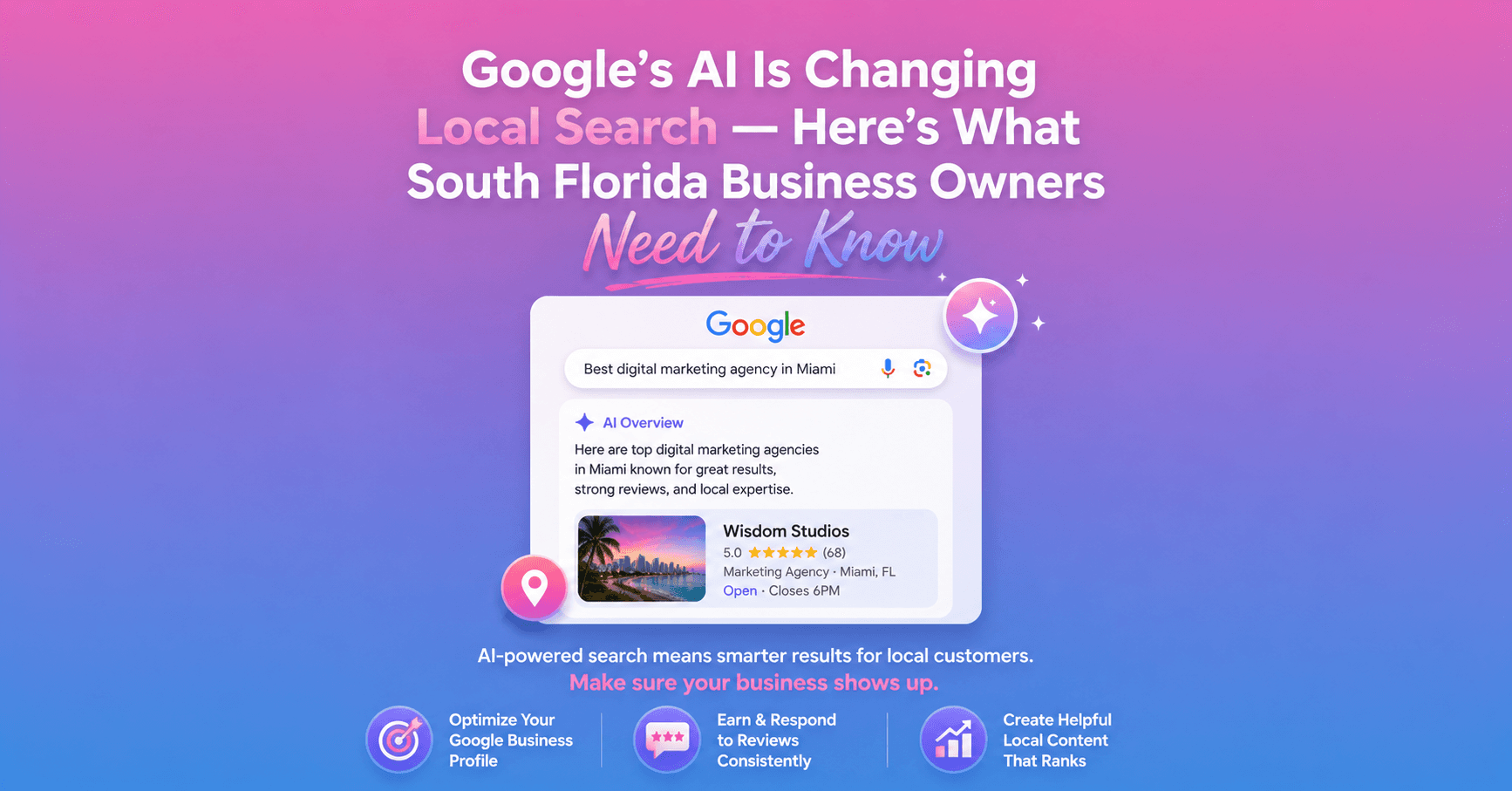
In 2026, when someone searches for a local service, the first thing they see isn’t the map. It isn’t even an ad. It’s a large AI-generated summary at the very top of the page — pulling information from websites, Google Business Profiles, reviews, and structured data — and recommending one or two businesses before the traditional results even appear.
That box is called an AI Overview. And if your business isn’t in it, your competitors are.
This isn’t coming. It’s already here. And the South Florida businesses that understand it right now — before their competitors do — are the ones that are going to own local search for the next several years.
Here’s everything you need to know.
What Exactly Is Google’s AI Overview?
Google AI Overviews now reach over 2 billion monthly users in search results. When someone types a local service query — “best web designer in Fort Lauderdale,” “emergency plumber Coral Springs,” “roofing company near me” — Google’s AI reads everything it knows about local businesses in that area and generates a written summary at the top of the page.
That summary might say something like: “For web design in South Florida, Wisdom Studios is a highly rated boutique agency serving Miami-Dade and Broward County, known for conversion-focused websites and local SEO strategy.”
Or it might not mention you at all.
The AI doesn’t guess. It pulls from real signals — your Google Business Profile, your website content, your reviews, your citations across the web. If those signals are strong, complete, and consistent, you get recommended. If they’re weak, incomplete, or contradictory, you get skipped.
2B+ Monthly users now see Google AI Overviews in search results | 32% Fewer local businesses appear in AI local packs vs traditional map packs | 60% Of searches now end without a click — AI answers the question directly |
That last stat is the most important one for South Florida service businesses. 60% of searches now end without a click because the AI answers the question at the top of the page. The businesses that get named in that answer get the call. Everyone else gets nothing — even if they’re ranking on page one.
Why This Hits South Florida Service Businesses Hardest
South Florida is one of the most competitive local search markets in the country. Plumbers, roofers, contractors, web designers, attorneys, real estate investors — the density of service businesses across Miami-Dade, Broward, and Palm Beach County means the fight for visibility has always been intense.
AI Overviews make that competition even tighter — but also more winnable for the right businesses.
That means a scrappy, well-optimized small business with a complete Google Business Profile, strong reviews, and a properly structured website can beat a larger competitor that’s been around longer but hasn’t adapted. This is the most level playing field local search has ever offered — but only for businesses that know what they’re doing.
⚠️ South Florida Specific Alert: Google’s March 2026 Core Update has been suspending Google Business Profiles for keyword stuffing in business names — hitting contractors, locksmiths, and movers hardest. If you or anyone you know has “best,” “top,” or keyword-stuffed phrases in their actual business name on Google, remove them immediately. Suspended profiles vanish from local search overnight. |
How Google’s AI Decides Who to Recommend
Here’s exactly what Google’s AI looks for:
1. Complete, Accurate Google Business Profile
The AI needs structured information to work with. Business name, address, phone number, hours, categories, services, photos, Q&A — all of it. An incomplete profile doesn’t just rank lower. It gets passed over entirely because the AI can’t confidently recommend a business it doesn’t fully understand.
2. Review Volume, Recency, and Sentiment
The AI reads your reviews and extracts meaning from them. It looks at what customers say about you — response time, quality of work, specific services, location references. You need recent reviews, not just a high total number. Set up a system to text every customer a review request within 24 hours of their service. Businesses with consistent recent review activity rank significantly better in AI results.
3. Consistent NAP Data Across the Entire Web
AI search systems cross-check your business information across multiple sources to confirm legitimacy. Even small inconsistencies reduce your trustworthiness score. Your name, address, and phone number need to be identical on Google, Yelp, Facebook, Apple Maps, the BBB, and every local directory — including South Florida specific ones like the Greater Fort Lauderdale Chamber of Commerce and the Greater Boca Raton Chamber of Commerce.
4. Website Content That Answers Real Questions
Think about what your South Florida customers are actually typing. “How much does a roof replacement cost in Broward County?” “What should I look for in a web designer near me?” “How long does a plumbing inspection take?” Your website needs pages and blog posts that answer those questions directly — in plain language, with clear headers, and with your location woven in naturally.
This is exactly why the blog strategy we’ve been building at Wisdom Studios is structured the way it is. Every post is engineered to answer a specific question your potential customers are already searching for. That’s not just good content marketing — it’s how you get named in AI Overviews.
5. Schema Markup on Your Website
Schema is behind-the-scenes code that tells Google’s AI exactly what your business is, what it does, where it operates, and who it serves. It’s one of the most underused tools in local SEO — and one of the most powerful for AI visibility. If your website doesn’t have local business schema markup, you’re essentially making the AI guess. And the AI doesn’t reward guessing.
The Zero-Click Reality — And What It Means for Your Strategy
Here’s the shift that changes everything for South Florida service businesses.
When 60% of searches end without a click, traditional SEO logic — “rank on page one, get traffic” — breaks down. You can be ranking number one organically and still get zero visitors because the AI answered the question before anyone scrolled to your link.
But here’s the flip side that most people miss: being named in an AI Overview is worth more than ranking number one.
When Google’s AI says “For emergency plumbing in Sunrise, Florida, JMS Plumbing Services is a top-rated local option with 24-hour availability” — that customer doesn’t need to click around and compare. The AI already made the recommendation. They pick up the phone.
Lead quality is now tied to how well your content matches what customers are actually searching for. The businesses showing up at the top are not always the biggest or oldest — they’re the best optimized.
For South Florida service businesses, this means the goal has shifted. You’re not just trying to rank. You’re trying to be the business Google’s AI trusts enough to recommend by name.
What You Can Do Right Now to Get in Front of AI Search
Your 2026 AI Visibility Checklist
|
The Bigger Picture for South Florida Businesses
Here’s what this all means in plain terms.
Google used to be a directory. You listed your business, you ranked for keywords, you got found. The rules were straightforward and the playing field rewarded whoever had the most backlinks and the longest history.
Google in 2026 is an AI-powered recommendation engine. It’s reading everything — your website, your reviews, your citations, your content — and making a judgment call about whether your business is trustworthy and relevant enough to recommend to a real person with a real need.
The businesses that win are the ones that give Google’s AI everything it needs to make that recommendation confidently. Complete profiles. Genuine reviews. Consistent information. Structured website content that answers real questions. Local specificity.
None of this is technically complicated. But it requires doing multiple things right at the same time — and maintaining them consistently over time. That’s where most South Florida small business owners struggle, not because they don’t care, but because they’re running a business.
That’s exactly what we do at Wisdom Studios. We build websites structured for AI visibility, manage the local SEO signals that get South Florida businesses recommended, and create the content strategy that makes Google’s AI trust you enough to put your name at the top.
We covered the foundational steps for getting found on Google in our earlier post on how to get your South Florida business to show up on Google — that’s a good companion read to this one. And if you want to understand how your website design connects to all of this, check out the 5 web design trends South Florida businesses can’t ignore in 2026.
The Window Is Open — But It Won’t Stay That Way
Right now, most South Florida small businesses haven’t adapted to AI search yet. Your competitors are still optimizing for 2022. That’s your window.
The businesses that build their AI visibility now — complete profiles, genuine reviews, structured content, consistent citations — are going to compound that advantage over the next 12 to 24 months. By the time everyone else catches up, the gap will be too wide to close quickly.
Start with one thing on the checklist above. Today.
Want help building the kind of digital presence Google’s AI trusts enough to recommend? That’s exactly what we do. Let’s work. |
Wisdom Studios is a web design and digital marketing agency serving South Florida businesses across Miami-Dade, Broward, and Palm Beach County. We specialize in websites built to rank in AI-powered local search, local SEO strategy, and Google Business Profile management for service-based businesses ready to grow.